

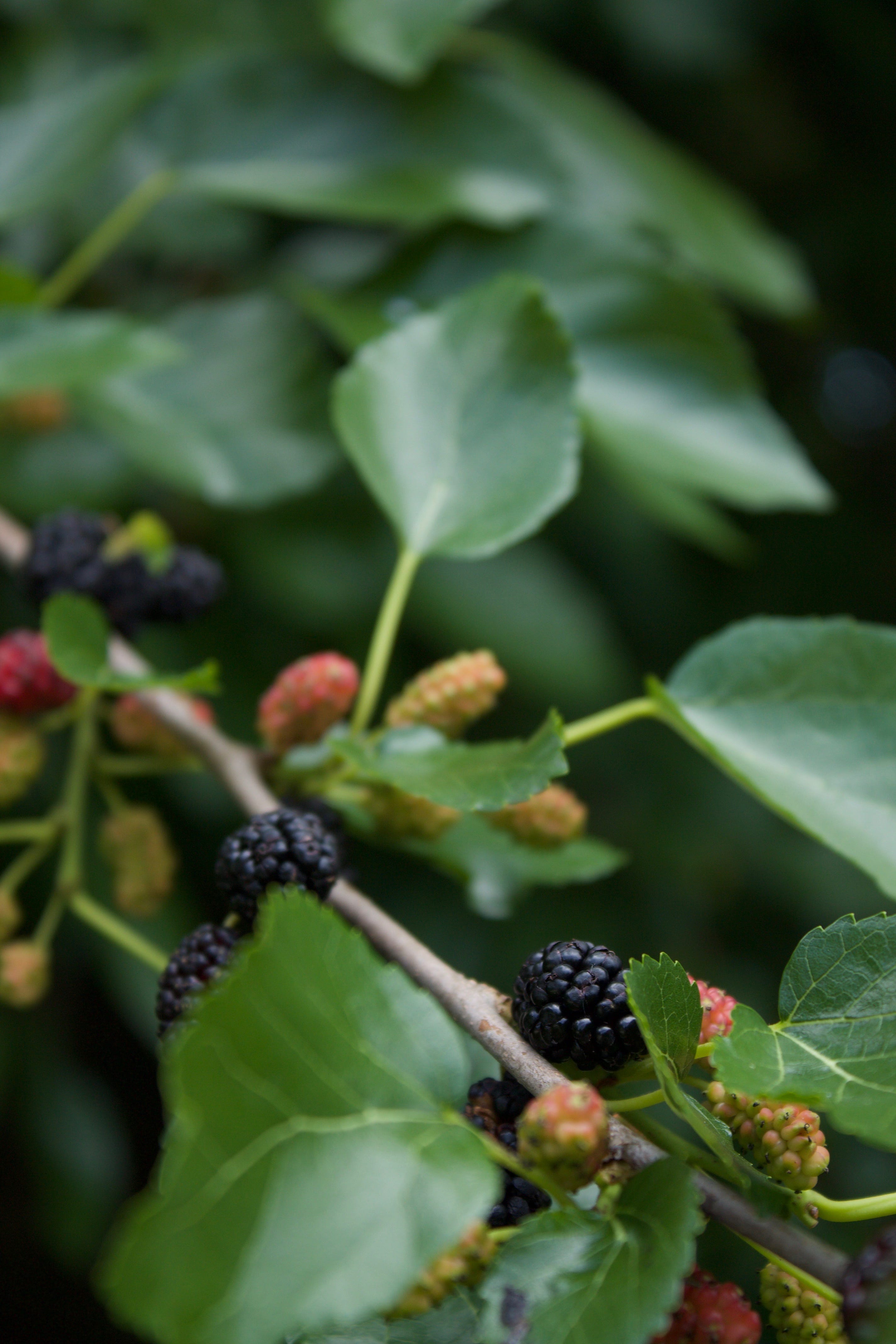
May is one of my favorite months of the year as a dedicated gatherer of wild fruits. In rapid overlapping succession mulberries, serviceberries, and black raspberries are ripening and ready for picking. With the Asian white mulberry (Morus alba) being such an aggressive (some would call invasive) species in both urban and rural areas, I can’t help but consider that mulberries may very well be the most prolific abundant non-cultivated edible fruit crop in North America. Mulberries aren’t just numerous in their stems however, they are an under-appreciated superfood containing anthocyanins, vitamins (A, B-6, C, E, K), niacin, iron, resveratrol, potassium, calcium, and magnesium.
Mulberries are first green, then become red before ripening into a dark purple to black color. I often visit single trees a dozen times or more over the course of 2-5 weeks most years. Harvesting mulberries in central Kentucky typically begins around the middle of May for trees located in full sun, and throughout June into early July for trees located in partial to full shade. Once you notice the mulberry ripening windows of your local area, remember them and plan accordingly each year. Where I work is located just under 40-miles south from where I live in Louisville and I’ve gathered my first handful this week (May 5th, 2026) from a single tree on the edge of a lake. I now have a few buckets in my car for big upcoming harvests.
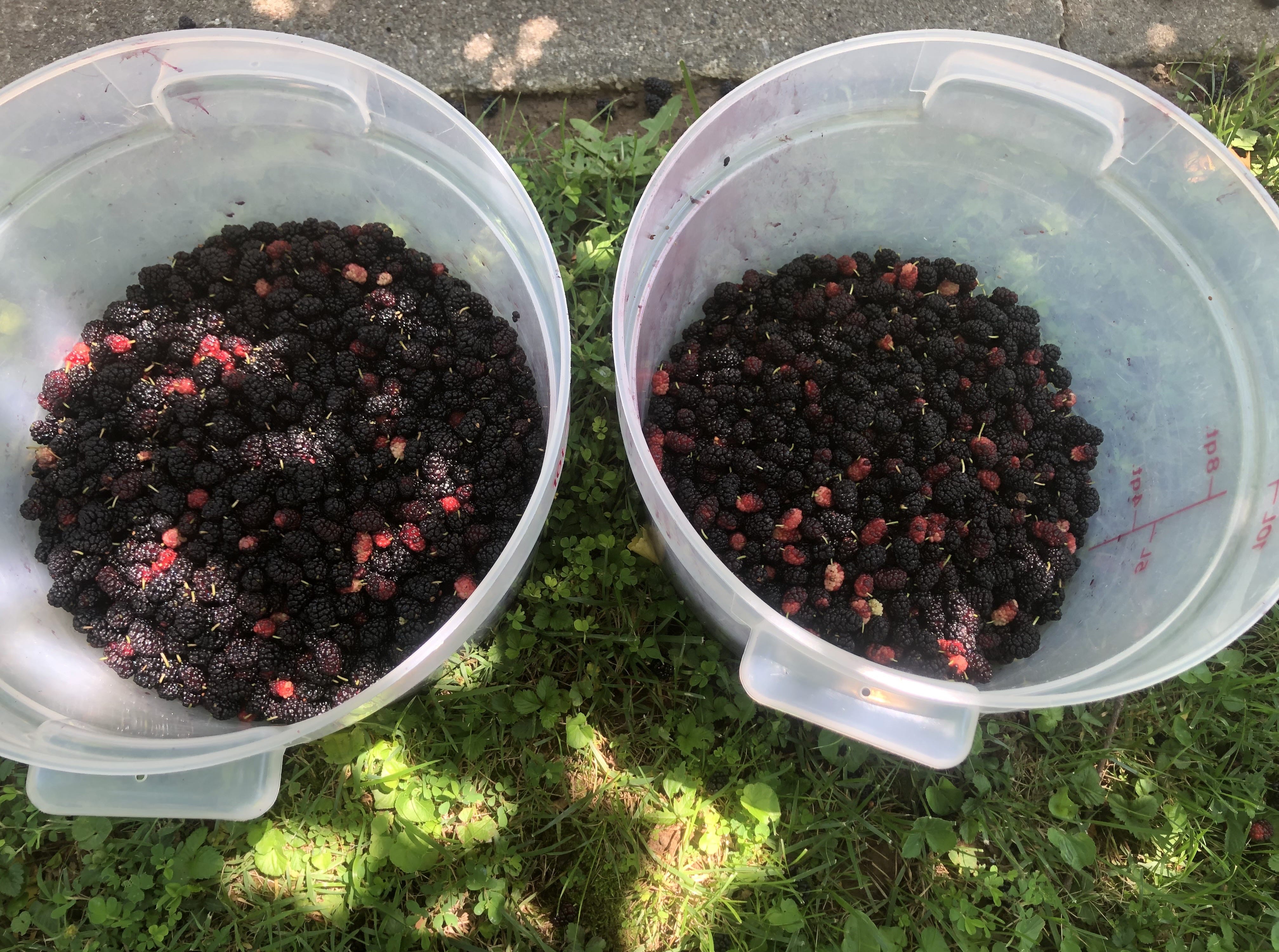
Mulberries prove that foraging doesn’t always have to require a lot of work and processing. While we do much of our harvesting by hand in the earlier half of the season when trees have both ripe and unripe fruit present, by the time that mulberry trees have mostly ripe fruit we shake their branches over large tarps (or sheets) to collect much larger quantities in just minutes. The only trade off with this approach is having to remove any unripened, dried or partially rotten fruit along with twigs and little critters by hand from your harvest. Hand gathering mulberries can yield a gallon or more from good trees in a half hour while shaking trees can triple that amount in just minutes from my experience. When it comes to processing the fruit, that depends on whether or not you decide to eat them fresh or not. Some folks rinse their mulberries off before eating, I don’t because they are delicate fruits and rinsing water over them seems to further damage the fruit while removing a bit of their flavor away. For storing freshly gathered mulberries, I suggest keeping them in a sealed container in the fridge and consuming them within a week from harvesting. The sooner the better. For mulberries that you wish to keep around for a longer period of time (having mulberries in the winter is a real treat), I’d recommend these two basic preservation techniques.
Freezing berries / This is the easiest way to store mulberries for up to two years. They thaw out great and retain their flavor well. *Note: Be sure the berries aren’t overly wet before freezing or they will turn into a less-flavorful ice block. Air dry fruit if necessary before freezing.
Dehydrate berries / If you have a dehydrator, this is a great way to preserve mulberries, especially if you have a large harvest that won’t overwhelm your storing capabilities. Spread out the mulberries in a single layer on your dehydrator shelves and let them dry for 12-24 hours at 135 degrees fahrenheight. *Note: Mulberries should be shriveled and break apart easily when properly dehydrated. Store them in an airtight container for later use (adding a couple grains of rice into the container can help absorb any potential moisture and help prevent mold).
Mulberries can be used in seemingly endless ways; smoothies, juice, jams, oatmeal, pies and other baked goods. I think it’s a great wild fruit to experiment with to find new ways of bringing out their incredible flavor. A fascinating traditional way to utilize mulberries is by adding them into a “boiled pudding”, which is an 18th century recipe from Hannah Glasses cookbook The Art of Cookery Made Plain and Easy (first published in 1747). To learn more about this recipe, checkout this video produced by Townsends.